


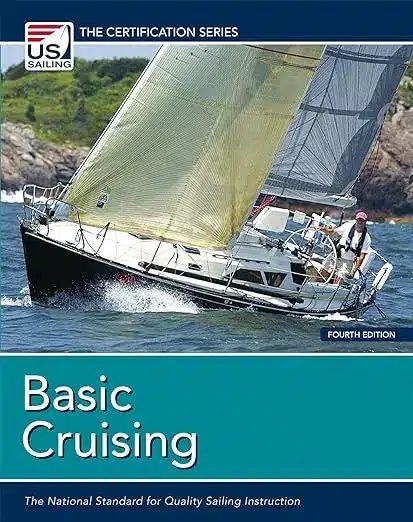
Prerequisites
The prerequisite for US Sailing Basic Cruising Certification is a US Sailing Basic Keelboat Certification.
Certification Requirements
A Basic Cruising graduate will have demonstrated the ability to responsibly skipper and crew an auxiliary-powered cruising sailboat during daylight hours, within sight of land, and in moderate wind and sea conditions.
To achieve the Basic Cruising Certification, candidates must successfully complete specified knowledge and skill requirements, demonstrating safe and confident boat handling in wind conditions ranging from 5 to 20 knots. In areas with stronger prevailing winds, certification is achievable if the candidate can safely manage the boat and recognize their limitations.
 3 DAY COURSE
DAY 1: SATURDAY YOU ARE BOOKING
DAY 2: FOLLOWING SUNDAY
DAY 3: SATURDAY ONE WEEK FROM START DATE
WWSC Members $695
Includes text book
Non Members $895
Textbook not included, must purchase separately from our office
Preparation to Sail:
- Demonstrate ability to recognize and forecast prevailing local weather conditions.
- Perform an inspection of running rigging, standing rigging and hull integrity.
- Check the inventory, location and operation of required safety equipment.
- Check the auxiliary power systems (as applicable to your boat): location and operation of engine controls, engine mechanical and fluids check, transmission controls, ventilation system and cooling system.
- Check the electrical system (as applicable to your boat): main battery switch, electrical control panel and battery terminals.
- Check the bilge pump system (as applicable to your boat): operation of manual and electrical pumps, intake maintenance and bilge pump alarms.
- Check the head systems (as applicable to your boat): location of controls, equipment operation, holding tanks and proper setting of valves.
- Check the fresh water system (as applicable to your boat): adequate quantity, operation of manual and electrical pumps, and proper setting of valves.
- Check the anchoring system (as applicable to your boat): anchors, shackles, rodes, chafing equipment and windlass.
- Check all other equipment specific to your boat not indicated above.
Crew Operations and Skills:
- Demonstrate winch operation and the proper procedure for clearing a fouled winch.
- Demonstrate tying and use of knots: clove hitch, sheet bend and rolling hitch. Review stopper knot, bowline, cleat hitch, round turn & two half hitches and square knot.
- Demonstrate how to heave a line.
- Demonstrate the use of sail controls: halyards, sheets, traveler, cunningham/downhaul, outhaul, adjustable backstay (if applicable), boom vang, leech lines, jib fairleads and boom toppinglift.
- Demonstrate the operation of a VHF radio: operation of controls, channel usage, call sign, weather channels and simulate an emergency call.
- Demonstrate a comprehensive crew briefing and plan of responsibilities.
Leaving the Dock or Mooring:
- Demonstrate appropriate helmsman and crew coordination and skills for departure under power suitable to the conditions: line handling, casting off, fending off and boathandling.
- Demonstrate the use of docklines, including springlines, for boat control while departing.
- Demonstrate stowing of docklines and fenders.
Boat Control in Confined Waters:
- Demonstrate in close quarters under power: speed and momentum control, windage and prop walk control, and command of the crew.
- Demonstrate ability to maneuver under sail in close quarters: short tacking and controlled jibes.
- Demonstrate a recovery plan for an engine failure in a crowded and busy harbor.
Navigation:
- Determine your position in open water, the position of your destination, your intended track and approximate travel time to that destination.
- Confirm your progress along that intended track with visual observations or with visual observations and electronic confirmation. Obtain and utilize relevant tide and current information. Using a chart, verify sufficient depth for a planned cruise.
Boat Control in Open Water:
- Demonstrate ability to steer a compass course with changes in course to a given destination.
- Demonstrate helm and boat control in a variety of wind and sea conditions.
Heavy Weather Sailing:
- Demonstrate proper reefing techniques: determining when to reef, roller furling or changing headsails, reefing the mainsail, dropping sails, shaking out a reef, and rehoisting underway.
- Demonstrate helm and boat control while sailing under shortened sail.
Overboard Rescue Methods:
- Properly demonstrate one of the overboard rescue methods, which is most appropriate for: your sailing ability, boat type, crew experience, wind and sea conditions, and maintaining constant visual contact with the person in water.
Safety and Emergency Procedures:
- Simulate procedure and operation of VHF radio in various emergency situations.
- Simulate failure of steering system, and demonstrate steering and boat control with sails.
Anchoring Techniques:
- Select an anchorage, and demonstrate appropriate helmsman and crew coordination and skills for properly anchoring with a single anchor under power.
- Demonstrate appropriate helmsman and crew coordination and skills for retrieving your anchor under power.
Returning to the Dock or Mooring:
- Demonstrate appropriate helmsman and crew coordination and skills for arrival under power suitable to the conditions: boathandling, deploying fenders, stopping and tying up.
- Demonstrate correct use and deployment of docklines, including springlines.
Securing the Boat Properly:
- Demonstrate stowing of sails, rigging and equipment. Thoroughly clean the boat, and install any covers and dock power equipment.
- Check both the electrical and bilge systems for dock operation.
- Check the locks on companionway, lockers and hatches. Make a final check of docklines, spring lines and fender placement.